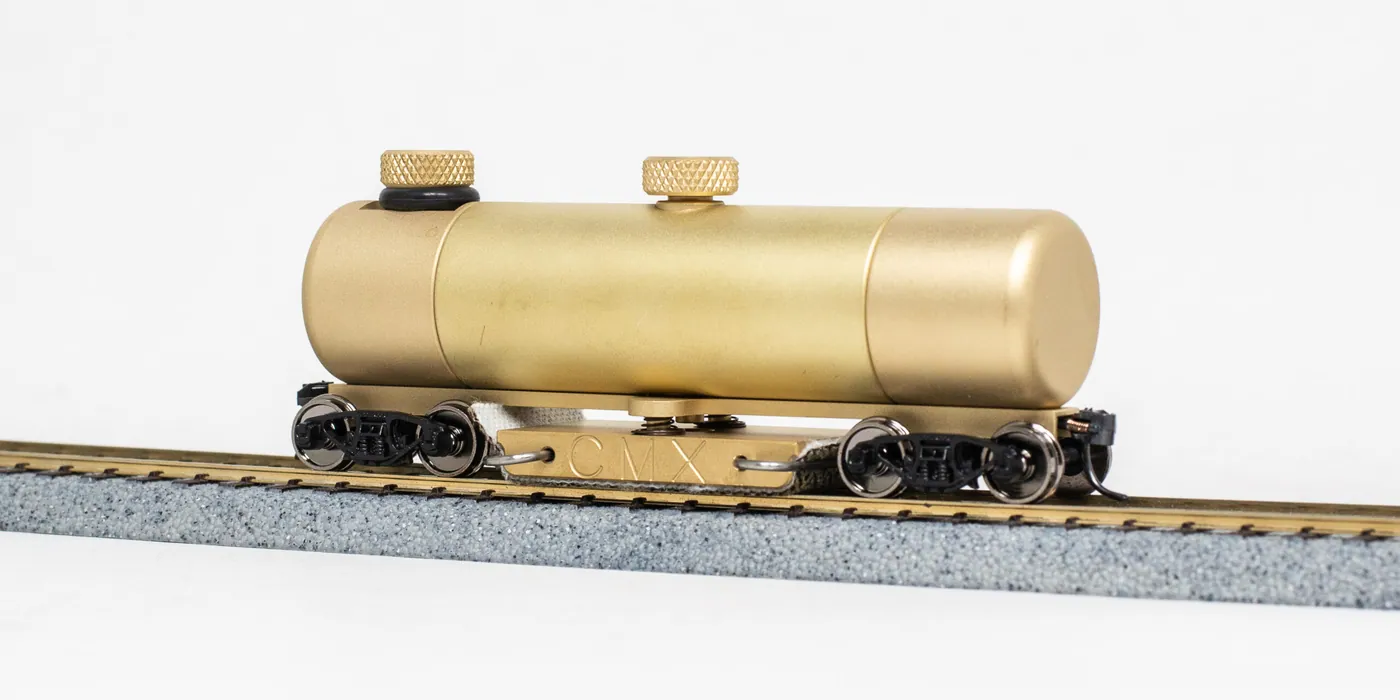
Lacquer thinner, mineral spirits, or DeOxit? Understanding what really keeps your model railroad running reliably.
Every model railroader knows the frustration. Your locomotive runs beautifully one day, then begins hesitating, flickering, or stalling the next. You clean the rails, everything works again, and a few weeks later you're back to cleaning.
More importantly, are we using the best cleaning fluids for the job?
At Tony's Train Exchange, we've spent decades helping model railroaders solve electrical pickup problems. Since its development in 1998, the CMX Clean Machine has become a trusted track maintenance tool for home layouts, clubs, and museums.
But the effectiveness of any track cleaning car depends on more than its mechanical design. The cleaning fluid itself plays an equally important role.
A recent discussion with longtime CMX customer Chris Monje prompted us to revisit this subject, drawing on the chemical analysis of Charlie Miller, more recent research published by Joe Fugate in Model Railroad Hobbyist, and Tony's own years of testing with DeOxit.
What we found reinforces an important point: The best track cleaning fluid depends on what you're trying to accomplish.
CMX HO Clean Machine Car Video Review
Why Does Model Railroad Track Get Dirty?
When most model railroaders think about dirty track, they picture dust, oil, grease, and the familiar black residue that accumulates on the railheads.
These contaminants interfere with the electrical connection between the rails and locomotive wheels, resulting in hesitation, flickering lights, interrupted sound, and sometimes complete loss of power.
But not all of that black residue comes from ordinary dirt.
In the January 2024 issue of Model Railroad Hobbyist, publisher Joe Fugate discussed research suggesting that a significant portion of the black contamination found on model railroad track consists of metal oxides associated with microscopic electrical arcing.
What Is Micro-Arcing?
Micro-arcing occurs when the electrical connection between a locomotive wheel and the rail is momentarily interrupted or becomes unstable.
Even though the interruption may be too brief to notice, tiny electrical arcs can occur at the contact point.
These arcs can contribute to oxidation and contamination, which may further degrade electrical pickup.
The result can become a frustrating cycle:
- Contamination interferes with electrical contact.
- Intermittent contact contributes to additional micro-arcing.
- More oxidation and residue accumulate.
- Electrical pickup becomes increasingly unreliable.
- The track needs cleaning again.
This leads to an interesting question.
What if the best cleaning fluid isn't necessarily the one that leaves the rails looking the cleanest, but the one that helps maintain reliable electrical contact for the longest period?
That's where solvent chemistry becomes important.
Polar vs. Non-Polar Solvents: Why Chemistry Matters
Joe Fugate's research highlights an important distinction between polar and non-polar cleaning solvents.
Polar Solvents
91% Isopropyl alcohol is a familiar example.
Alcohol is effective at dissolving certain contaminants, evaporates relatively quickly, and has been widely used by model railroaders for decades.
However, the research Joe discusses suggests that polar solvents may leave metal contact surfaces more susceptible to recurring micro-arcing, potentially allowing contamination to return more quickly.
Non-Polar Solvents
Mineral spirits and naphtha are examples of non-polar solvents.
These products have different chemical characteristics, and research cited by Joe suggests they may help reduce the conditions associated with micro-arcing.
The practical implication is that non-polar solvents may allow the rails to remain electrically reliable for longer periods between cleaning sessions.
This doesn't mean alcohol is automatically a poor cleaner. It means cleaning performance and long-term electrical contact performance are two different considerations.
It is also important to recognize that the specific mechanisms and long-term advantages of different solvent types continue to be discussed within the hobby. Results can vary depending on rail material, wheel condition, operating environment, and maintenance practices.
The CMX Clean Machine: A Design That Began in 1998
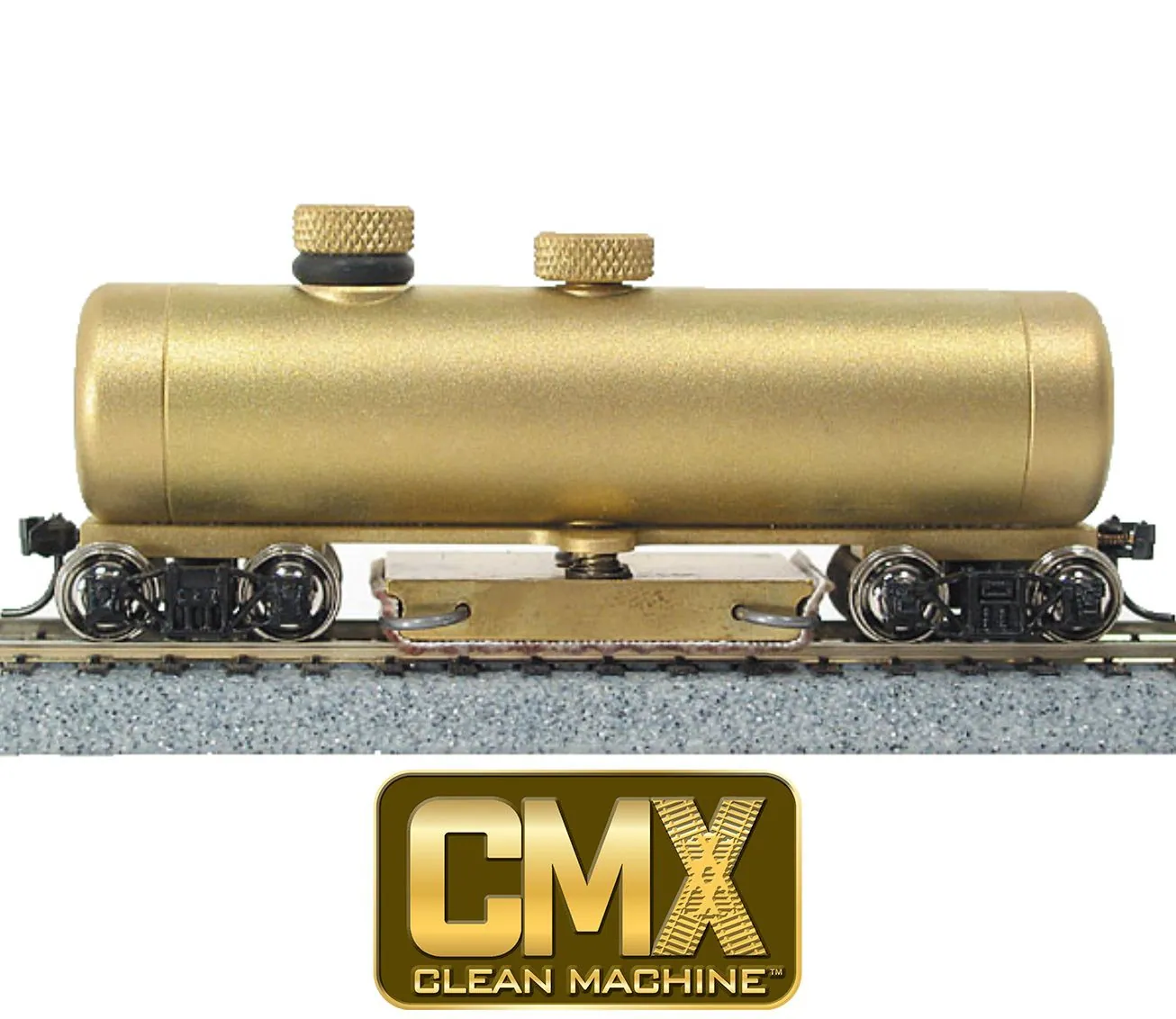
In 1998, Erik Fiske developed the CMX Clean Machine to provide model railroaders with an effective and consistent method of cleaning their track.
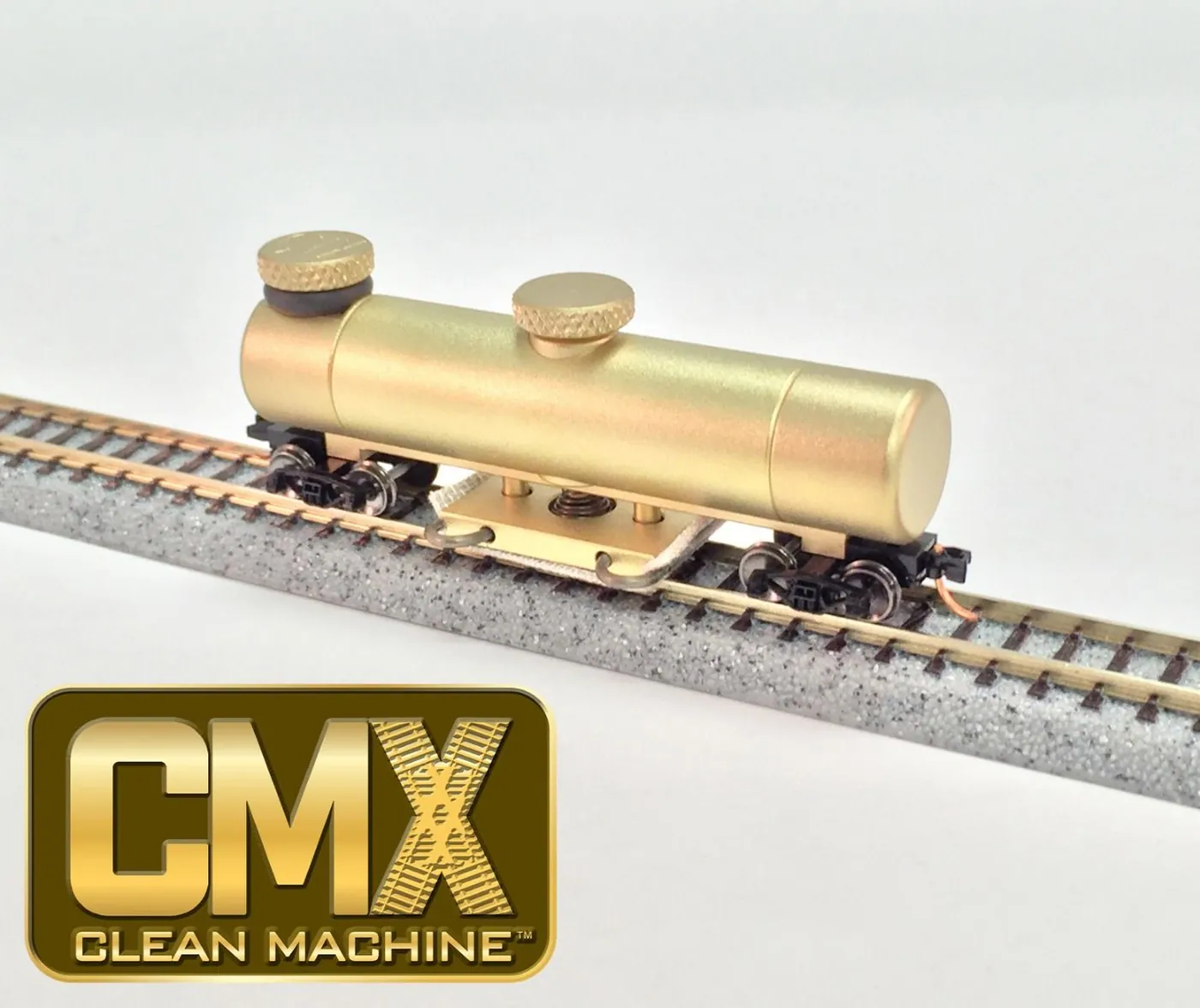
The design incorporates a substantial brass body, an adjustable fluid delivery system, and a replaceable cleaning pad that maintains contact with the railheads.
The weight of the brass body helps provide consistent cleaning pressure, while the adjustable valve controls the amount of fluid delivered to the pad.
As the car moves across the layout, the combination of solvent action and mechanical wiping removes contamination from the rails.
The design allows operators to clean long stretches of track, including areas that are difficult to access by hand.
Over the years, the CMX has become a familiar piece of maintenance equipment on layouts ranging from small home railroads to large club and museum installations.
But even the best-designed cleaning equipment depends on selecting a suitable fluid.
Charlie Miller's Chemical Review: Why Lacquer Thinner Was Recommended
Charlie Miller, a chemist, authored a detailed review of track cleaning solvents and their chemical properties for us in 2002.
His analysis explored how different solvents interact with the types of contamination commonly found on model railroad rails.
Charlie recommended lacquer thinner as a highly effective general-purpose cleaning agent.
From a chemical standpoint, that recommendation makes sense.
Lacquer thinner is typically a blend of aggressive solvents capable of dissolving many types of stubborn contamination, including grease, oil, and certain deposits left behind by scenery materials and other substances.
For heavily contaminated track, it can provide substantial cleaning action.
Why Not Use Lacquer Thinner for Everything?
Although lacquer thinner can be an excellent cleaning solvent, it also has disadvantages.
It is highly flammable, produces potentially hazardous vapors, and can damage plastic components, painted surfaces, scenery, and certain adhesives.
Its exact chemical composition also varies by manufacturer.
For these reasons, a powerful solvent like lacquer thinner may be unnecessary for a railroad that is already relatively clean and receives regular maintenance.
Charlie's chemical review also discussed non-polar solvents such as mineral spirits and lighter fluid.
That makes his earlier work particularly interesting when compared with the more recent discussion of solvent polarity and micro-arcing.
Both perspectives offer useful insight into how we should approach track cleaning.
Odorless Mineral Spirits: A Strong Choice for Routine Cleaning
Our recent correspondence with Chris Monje brought odorless mineral spirits into focus.
Chris has been using odorless mineral spirits in his CMX Clean Machine on his home railroad and shared his observations along with Joe Fugate's research.
For routine track cleaning, there are several reasons to consider this approach.
Odorless mineral spirits:
- Dissolve many common oils, greases, and rail contaminants.
- Are non-polar solvents.
- Generally have less aggressive solvent action than lacquer thinner.
- Produce less noticeable odor than conventional mineral spirits.
- May help extend the interval between cleaning sessions, based on the operating experiences described by Joe Fugate and other model railroaders.
For a layout that is already in reasonably good operating condition, odorless mineral spirits may provide an excellent balance of cleaning effectiveness and long-term maintenance.
There is one important distinction: odorless does not mean harmless. Mineral spirits still require adequate ventilation, careful handling, and attention to their flammability and compatibility with nearby materials.
They also evaporate more slowly than alcohol or many lacquer thinner formulations, so avoid excessive application.
For routine CMX maintenance, odorless mineral spirits would be our first choice to evaluate on a regularly operated layout.
But what if the primary problem isn't ordinary dirt?
What if oxidation has already developed and locomotives are experiencing poor electrical pickup?
That's where our experience with DeOxit becomes particularly interesting.
Tony's DeOxit Testing: A Different Approach to Electrical Pickup Problems
Back in January 2017, Tony's published an article titled Track Cleaning — NEW IMPROVED CMX OPERATION!
The article described testing we conducted using CAIG DeOxit D100L mixed with 91% isopropyl alcohol.
Unlike conventional cleaning solvents, DeOxit is designed for improving electrical contact by treating oxidation and contamination on conductive surfaces.
We wanted to determine whether it could help improve wheel-to-rail electrical pickup when applied using the CMX Clean Machine.
The Tony's DeOxit Cleaning Formula
Our tested mixture was:
95% by volume of 91% isopropyl alcohol
5% by volume of CAIG DeOxit D100L
It's important to emphasize that the alcohol used in our testing was 91% isopropyl alcohol, not 99%.
As a convenient approximation, our original article described adding a 25 mL bottle of DeOxit D100L to a pint bottle of 91% isopropyl alcohol and shaking the mixture.
This produces a concentration close to 5%, which was the target used in our tests.
What Did We Discover?
We used this mixture in an HO scale CMX Clean Machine as part of our maintenance operations.
The alcohol helped remove grease, oil, and general contamination, while the DeOxit was intended to help address metal oxides interfering with electrical contact.
The improvement in operating reliability was noticeable.
We also used the mixture on the operating O gauge railroad at Vermont's Shelburne Museum, where dependable performance is especially important.
Locomotives that had experienced electrical pickup problems ran more reliably after treatment.
The solution was also useful for cleaning locomotive wheels.
These results demonstrated that the DeOxit mixture could be an effective maintenance treatment for layouts experiencing oxidation-related problems.
One Important Trade-Off: Reduced Traction
Our original testing also revealed an interesting side effect.
Immediately after cleaning, we observed an estimated 10% reduction in locomotive tractive effort.
In other words, the locomotives experienced slightly more wheel slip until the effect diminished.
This is particularly relevant for layouts with steep grades, long trains, or locomotives operating near their traction limits.
For that reason, the DeOxit mixture is best viewed as an occasional electrical-contact treatment rather than something that necessarily needs to be applied during every routine cleaning session.
Doesn't the DeOxit Mixture Contradict the Research on Alcohol?
At first glance, it might seem that way.
Joe Fugate's research favors non-polar solvents for long-term prevention of recurring contamination.
Yet Tony's has documented successful results with a mixture containing 91% isopropyl alcohol.
The distinction is the purpose of each treatment.
Mineral spirits are being considered primarily for routine cleaning and potentially extending the time between cleanings.
The DeOxit mixture is being used to help restore electrical performance when oxidation and poor electrical pickup have already become problems.
The alcohol serves as the cleaning carrier, while the DeOxit provides the contact-treatment component.
Our tests demonstrated improved operation in the conditions we encountered, but they were not controlled, long-term comparisons against mineral spirits.
Therefore, the two approaches should not be considered directly interchangeable or universally superior to one another.
Instead, they provide different options for different maintenance needs.
Which Cleaning Fluid Should You Use?
Based on the chemical review by Charlie Miller, Joe Fugate's research, and our own testing and operating experience, here's how we would approach choosing a cleaning fluid.
| Cleaning fluid | Best application | Main consideration |
|---|---|---|
| Odorless mineral spirits | Routine track cleaning and preventive maintenance | Non-polar, less aggressive than lacquer thinner, slower evaporation |
| 95% 91% isopropyl alcohol + 5% DeOxit D100L | Occasional treatment for oxidation and unreliable electrical pickup | Demonstrated improvements in Tony's testing; temporary traction reduction possible |
| Lacquer thinner | Heavy contamination and stubborn deposits | Aggressive cleaning action; significant vapor, fire, and material-compatibility precautions |
For most layouts that are already operating reliably, we would start with odorless mineral spirits.
If locomotives are experiencing repeated electrical pickup problems that appear to be related to oxidation, our previously tested DeOxit mixture is another option worth considering.
Lacquer thinner remains useful for stubborn contamination that less aggressive cleaners cannot remove, provided the operator can use it safely.
Six Tips for Getting the Most from Your CMX Clean Machine
Regardless of which fluid you select, the way you use your CMX makes a difference.
1. Start with a clean pad.
The CMX cleaning pad physically collects contamination as the car moves across the rails. Replace the pad when it becomes heavily soiled.
2. Adjust the fluid flow carefully.
The CMX's adjustable valve allows you to control the amount of cleaning fluid delivered to the pad. Use enough for effective cleaning without excessively wetting the track or surrounding scenery.
3. Don't forget rolling stock wheels.
Cleaning the rails accomplishes little if dirty locomotive wheels immediately transfer contamination back onto them. Track and wheel maintenance should go together.
4. Pay attention to lightly used track.
Sidings, staging yards, industrial tracks, and other less frequently used sections often require additional attention.
5. Avoid unnecessary abrasive cleaning.
Abrasive cleaning blocks and sandpaper may remove stubborn oxidation, but repeated aggressive abrasion can scratch or alter rail surfaces. Start with appropriate non-abrasive methods whenever possible.
6. Don't assume every stall is caused by dirty track.
Loose rail joiners, insufficient feeders, defective wheel pickups, and other wiring problems can produce symptoms that resemble dirty rails.
If cleaning doesn't correct the problem, investigate the electrical system rather than repeatedly applying stronger chemicals.
A Safety Reminder
All three cleaning approaches require appropriate precautions.
Consult the manufacturer's label and Safety Data Sheet for the exact product you intend to use. Keep solvents away from sparks, flames, and other ignition sources, provide adequate ventilation, and check compatibility with scenery, painted surfaces, plastics, rubber tires, and adhesives.
Do not mix cleaning chemicals indiscriminately. The DeOxit formula described here is a specific mixture previously tested by Tony's, not a general recommendation to combine different cleaning products.
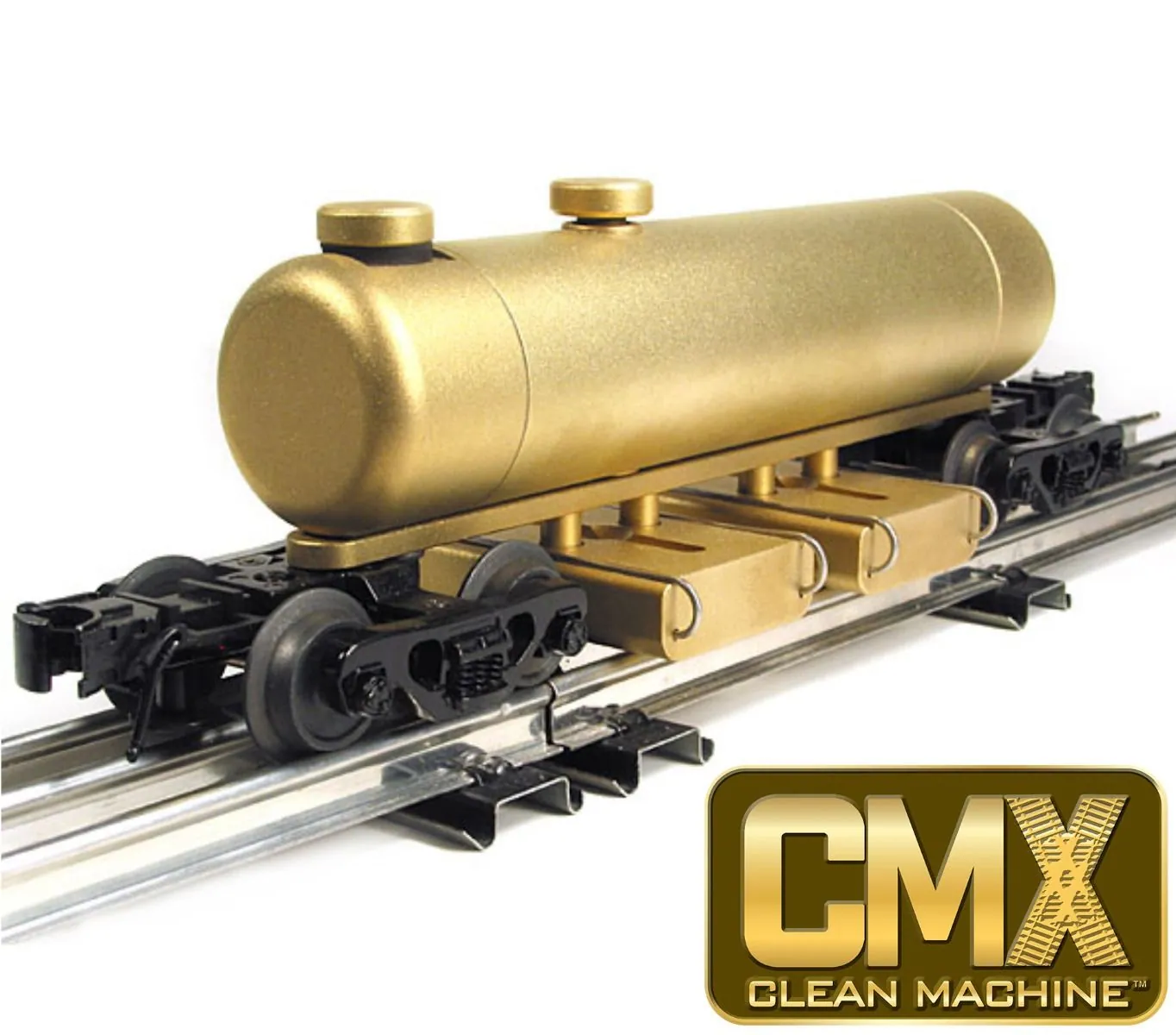 O 3 Rail CMX Clean Machine
The Shelburne Museum: CMX Cleaning in Action
One of the interesting aspects of our correspondence with Chris Monje was learning more about the railroad maintenance operations at Vermont's Shelburne Museum.
Chris helps maintain the museum's operating train displays, including its S gauge American Flyer railroad and seasonal O gauge Winter Lights layout.
The American Flyer exhibit has a history dating back to the early 1950s, when A.C. Gilbert provided a train display for the museum.
The current S gauge railroad uses nickel silver track and undergoes regular maintenance, including a weekly cleaning and operational check.
An S gauge CMX Clean Machine is a standard part of that routine [we no longer produce the S scale version].
The museum also uses a CMX for cleaning its seasonal O gauge layout featuring Lionel FasTrack.
These displays provide an excellent example of why consistent track maintenance matters.
When a railroad is running for museum visitors, reliability isn't simply convenient. It's essential.
Our earlier DeOxit testing at the museum, combined with its continued use of CMX cleaning equipment, demonstrates the value of matching an effective cleaning process to the requirements of the railroad.
Video Review CMX Clean Machine Track Cleaning Car Review for 3-Rail O-Scale
Final Thoughts: Cleaner Track, Better Electrical Pickup, More Reliable Trains
After nearly three decades of CMX Clean Machine operation and testing, we're still learning more about what makes a track cleaning program effective.
Erik's original CMX design in 1998 provided model railroaders with a practical mechanical solution for cleaning rails.
Charlie Miller's chemical review helped explain the advantages and limitations of different cleaning solvents.
Joe Fugate's more recent work has encouraged the hobby to look more closely at micro-arcing, contamination, and the potential advantages of non-polar cleaning products.
And our own field testing with DeOxit has demonstrated that treating oxidation-related electrical pickup problems can produce meaningful improvements in locomotive performance.
The lesson is that effective track maintenance involves more than simply removing visible dirt.
It's about maintaining consistent electrical contact between the wheels and rails while minimizing recurring contamination.
For routine maintenance, odorless mineral spirits are an option we particularly like.
For oxidation-related pickup problems, Tony's previously tested mixture of 95% 91% isopropyl alcohol and 5% DeOxit D100L remains a valuable treatment to consider.
For severe contamination, lacquer thinner can still provide aggressive cleaning action when used with appropriate precautions.
Ultimately, the best cleaning approach is the one that keeps your locomotives running reliably with the least unnecessary maintenance.
Because the goal isn't to spend more time cleaning track.
It's to spend more time running trains.
Additional Reading and Resources
Tony's Tips — Track Cleaning: NEW IMPROVED CMX OPERATION! (January 2017)
CMX Clean Machine — Operating Manual and Chemical Review
Model Railroad Hobbyist — January 2024
Joe Fugate's discussion of track cleaning, solvent chemistry, micro-arcing, and solvent safety.
Tony's Train Exchange manufactures the CMX Clean Machine and specializes in DCC electronics, circuit protection, model railroad electrical products, and technical support.
Questions about track cleaning or improving your railroad's electrical reliability? Visit Tonystrains.com or call 800-978-3472.