Protect It. Measure It. Know What Your Layout Is Really Doing.
How much current is your DCC layout actually using?
Is your booster delivering the voltage you expect?
How much current does that sound-equipped locomotive really draw? What happens when you add another train? Are you losing voltage between your booster and the far end of the railroad?
And when your circuit breaker trips, do you know why?
These are questions that are difficult to answer by observation alone.
That's why at Tony's we like to think about DCC power management as two complementary jobs:
The DCC Specialties PSXX protects your layout.
The DCC Specialties RRampMeter measures what's happening on it.
Used together, they give you a much clearer picture of the electrical health of your railroad.
The Problem: DCC Power Is Hard to See
Your trains may be running perfectly while the electrical load on the layout is gradually increasing.
Add another sound locomotive.
Then another.
Add passenger-car lighting, stationary decoders, accessories and locomotives equipped with Keep Alives.
Eventually you may begin seeing symptoms:
- Circuit breakers that trip unexpectedly
- Locomotives resetting
- Sound cutting out
- Lights flickering or dimming
- Slower operation in certain areas
- Problems that appear only when several trains are operating
Without measurements, troubleshooting can become guesswork.
A RRampMeter lets you stop guessing.
What Is a RRampMeter?
The DCC Specialties RRampMeter is a meter designed specifically for model railroad electrical systems.
Unlike many conventional meters, the RRampMeter is designed to accurately measure the unusual waveform produced by a DCC system.
It measures true RMS voltage and current and automatically works with:
DCC • DC • AC
That's important because DCC isn't ordinary household AC. It is a high-frequency digital waveform, and a conventional meter may not provide an accurate DCC reading.
The RRampMeter continuously samples the signal and calculates its RMS value, providing an accurate measurement independent of the waveform.
Accuracy is specified at ±2%.
For a model railroad, that makes it an extremely useful tool for both monitoring and troubleshooting.
Voltage and Current Tell You Different Things
Understanding this distinction makes the RRampMeter much more useful.
Voltage
Think of voltage somewhat like water pressure.
To measure DCC track voltage, you place the RRampMeter across the rails.
That makes it easy to move around the railroad checking voltage at different locations.
For example, you can compare the voltage near your command station or booster with the voltage at the far end of the layout.
If there's a significant difference under load, you may have discovered a wiring problem.
Current
Current is different.
Think of current as the amount of water actually flowing through the pipe.
To measure it, the electrical current must flow through the RRampMeter.
That means the RRampMeter is connected in series with the circuit being measured.
This allows you to see exactly how much current your railroad—or an individual power district—is consuming.
How Much Current Is Your Layout Really Using?
This is where the RRampMeter becomes particularly useful.
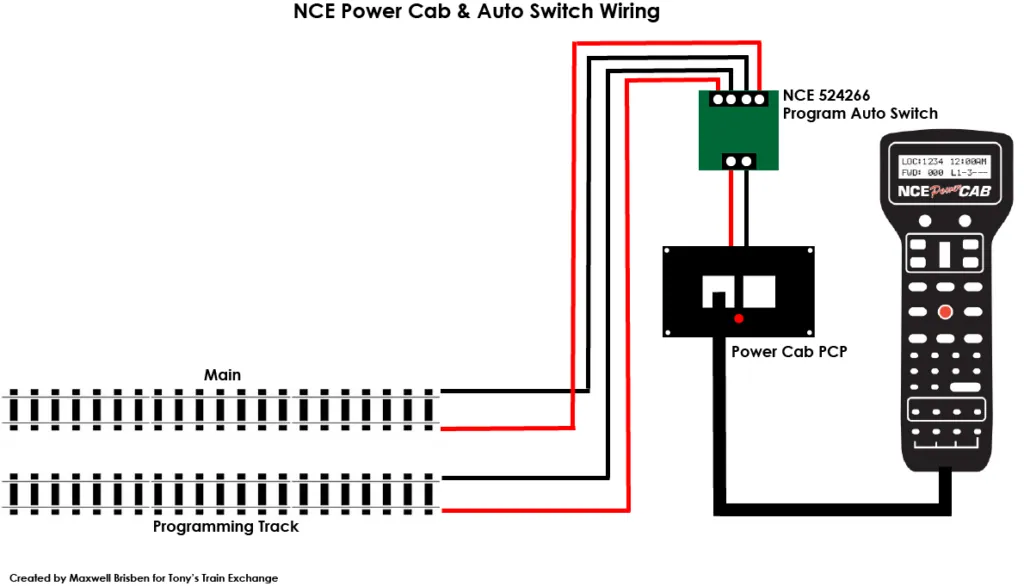
Suppose you have an NCE Power Cab.
The Power Cab provides approximately 2 amps of DCC power.
But how much of that capacity are you actually using?
You could have several locomotives sitting on the railroad with sound operating, passenger cars with lighting, stationary decoders and other loads.
The RRampMeter gives you an actual number.
Instead of:
"I think I'm getting close to the limit."
you can know:
"My railroad is currently drawing 1.35 amps."
That's a much better basis for deciding whether you need to redistribute loads, create additional power districts or eventually add more power.
Where Does the PSXX Fit In?
The DCC Specialties PSXX is the protection side of the equation.
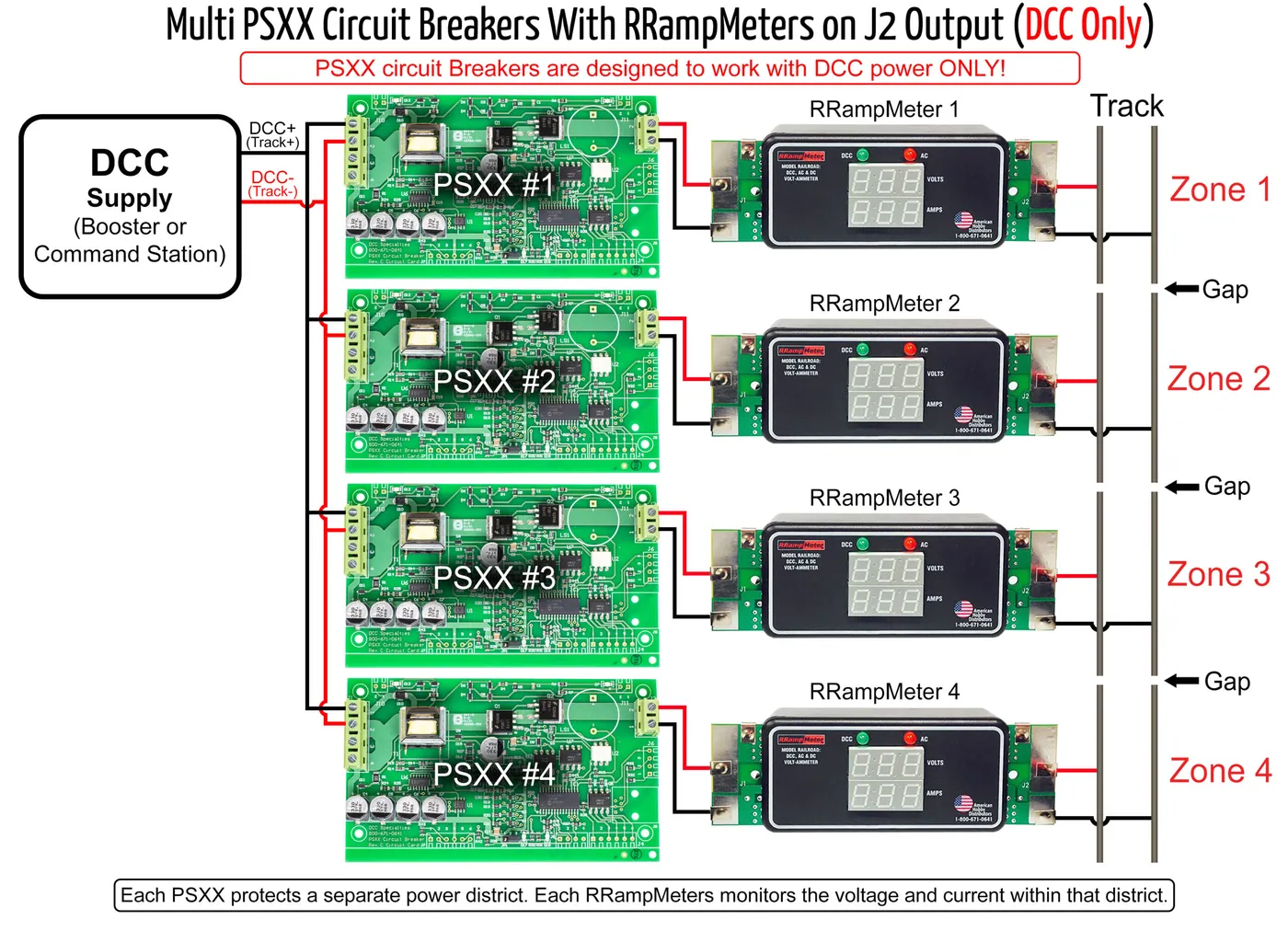
The PSXX is an electronic DCC circuit breaker designed to protect a power district when a short circuit or excessive load occurs.
So we have two different jobs:
PSXX = Protect
RRampMeter = Measure
Put them together and you have a very effective DCC power-management system.
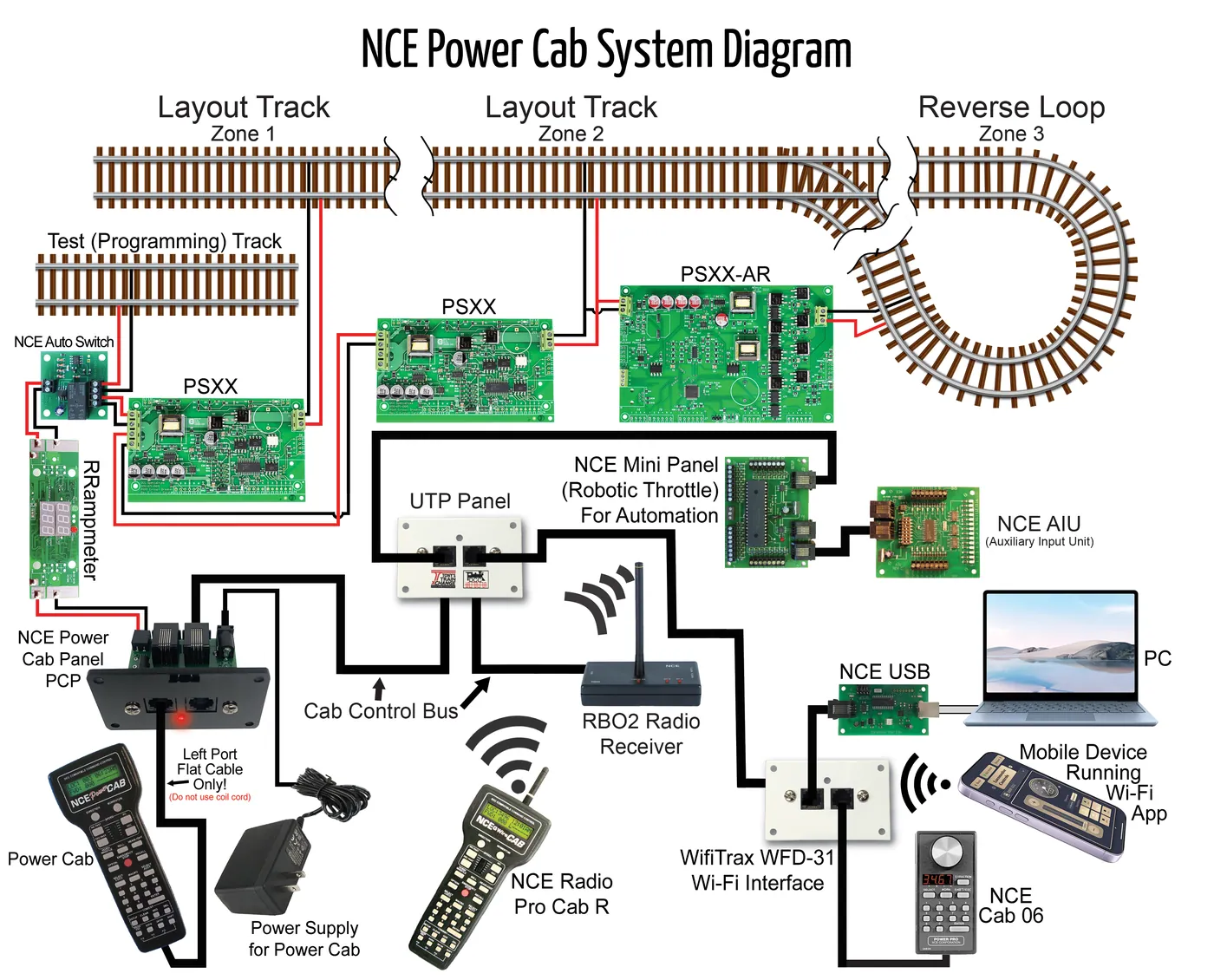
For a simple Power Cab installation, for example:
NCE Power Cab → PSXX → RRampMeter → Track
The Power Cab supplies and controls DCC power.
The PSXX protects the power district.
The RRampMeter shows you the voltage and current actually being delivered to the railroad.
That's a very useful combination.
Should the RRampMeter Go Before or After the PSXX?
Either arrangement can work.
But what you want to measure determines the best location.
RRampMeter Before the PSXX
Booster → RRampMeter → PSXX → Track
In this arrangement, the RRampMeter measures the power being supplied to the circuit breaker.
One advantage is that the meter remains powered if the circuit breaker disconnects the track.
RRampMeter After the PSXX
Booster → PSXX → RRampMeter → Track
This is often the more informative arrangement if your goal is to monitor the power actually reaching the railroad.
The meter is measuring on the protected side of the circuit breaker, so the voltage reading more closely represents what the locomotives are receiving.
If the PSXX turns the district off, however, a track-powered RRampMeter will also turn off.
Fortunately, the voltage difference across a PSXX during normal operation is small, so either location can be useful.
One RRampMeter or One for Every Power District?
You don't necessarily need a meter for every district.
It depends on what you want to know.
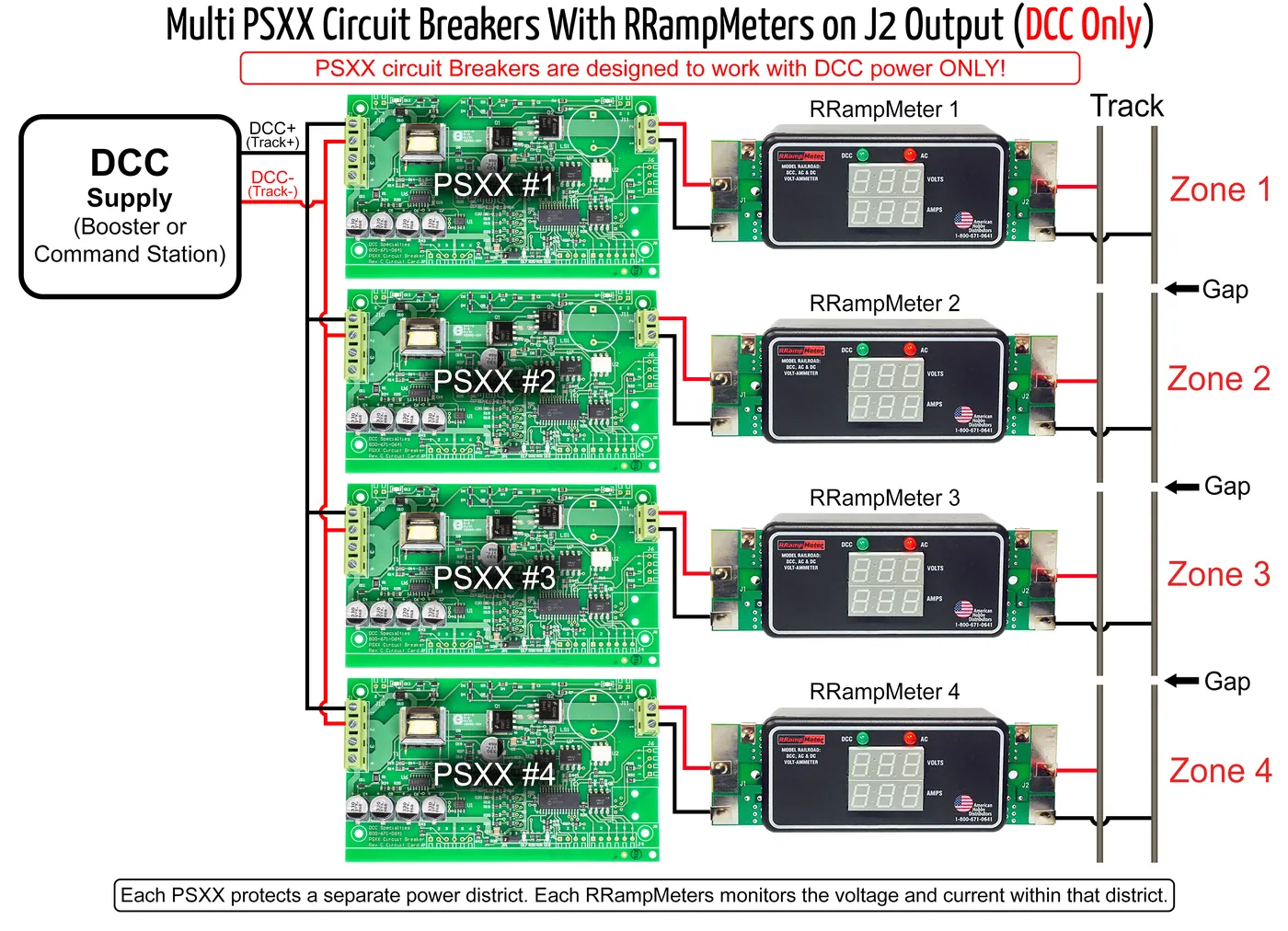
Install one RRampMeter at the booster output and you can monitor the total current being supplied to the layout.
If you want to continuously monitor individual power districts, each district needs its own current measurement.
For example:
Booster
→ PSXX District 1 → RRampMeter → Track
→ PSXX District 2 → RRampMeter → Track
→ PSXX District 3 → RRampMeter → Track
Now you can see exactly how much current each district is using.
That's particularly useful on larger layouts because it makes load balancing and troubleshooting much easier.
But there's another approach.
Use one RRampMeter as a portable diagnostic tool.
You can move around the railroad checking voltage and temporarily insert the meter into a circuit when you need to measure current.
Both approaches work.
Find Voltage Drop Before It Becomes a Problem
One of our favorite uses for the RRampMeter is diagnosing voltage drop.
A layout can show normal voltage near the booster but substantially less voltage farther down the railroad when it's under load.
Possible causes include:
- Undersized bus wiring
- Long wire runs
- Too few feeders
- Poor electrical connections
- Loose terminals
- Rail resistance
- Problematic rail joiners
Simply measuring unloaded track voltage may not reveal the problem.
The better test is to apply a known load and compare voltage measurements at different locations.
If the voltage drops substantially farther away from the booster, you've learned something important about the layout wiring.
Instead of replacing decoders, blaming locomotives or changing circuit-breaker settings, you can address the actual electrical problem.
Use the RRampMeter to Understand Your PSXX
The RRampMeter is also an excellent companion when setting up a PSXX.
Circuit-breaker settings shouldn't be arbitrary.
You want the PSXX configured appropriately for both your DCC system and the expected load in the power district.
Knowing the district's normal current consumption gives you valuable information.
For example, if a district normally consumes relatively little current, but you're experiencing occasional trips, the RRampMeter can help determine whether the problem is:
- A genuine overload
- A momentary current spike
- A locomotive or accessory drawing unusual current
- A wiring issue
- Or a short circuit
The PSXX tells you there's a problem.
The RRampMeter can help you understand what the electrical system was doing.
That's a powerful combination for troubleshooting.
Which RRampMeter Do You Need?
DCC Specialties offers several versions of the RRampMeter.
RRampMeter I
The circuit-board version is ideal for panel mounting or permanent installation.
It handles up to 10 amps and is a great choice when you want a meter permanently monitoring your DCC system or a power district.
RRampMeter II
The RRampMeter II puts the meter in an enclosure, making it convenient for portable troubleshooting as well as permanent use.
It also handles up to 10 amps.
RRampMeter III
Version III adds an independent 9V battery power option.
Why is that useful?
The standard RRampMeter normally powers itself from the circuit being measured. The battery option allows Version III to make measurements when the voltage being measured is too low to power the meter itself.
For normal DCC track-voltage measurements this generally isn't necessary because DCC track voltage is already high enough to operate the meter.
But the battery option is useful for low-voltage testing and DC applications.
RRampMeter IV
The RRampMeter IV is the high-power version, intended for applications such as O and Large Scale where higher voltage and current capability is required.
It is rated for up to 20 amps.
A Meter Designed for Model Railroaders
You can certainly own a very good conventional multimeter and still find a RRampMeter useful.
The RRampMeter isn't intended to replace every function of a general-purpose multimeter.
Its advantage is specialization.
It was designed around the electrical measurements model railroaders routinely need:
DCC voltage.
DCC current.
Booster loading.
Power-district loading.
Voltage-drop troubleshooting.
And because it's available in portable and panel-mount configurations, it can serve as either a troubleshooting instrument or a permanent layout monitor.
The Complete Tony's Approach to DCC Power
We think a well-designed DCC electrical system should do three things:
POWER IT
Start with a properly sized DCC command station or booster.
For a smaller railroad, the NCE Power Cab remains one of our favorite choices.
PROTECT IT
Divide and protect the railroad appropriately with a fast electronic circuit breaker such as the DCC Specialties PSXX.
A short in one location shouldn't have to become a mystery—or put unnecessary stress on your DCC system.
MEASURE IT
Use the DCC Specialties RRampMeter to see the voltage and current your railroad is actually using.
Because once you can measure what's happening, DCC electrical troubleshooting becomes much less about guessing.
Power It → Protect It → Measure It.
That's the foundation of good DCC power management.
How Much Current Is Your Layout Really Using?
There's only one good way to answer that question:
Measure it.
Whether you're setting up a new NCE Power Cab, adding PSXX circuit protection, balancing several power districts or troubleshooting an established railroad, the RRampMeter gives you information that is otherwise difficult to see.
And that's why we consider it one of the most useful electrical tools a DCC model railroader can own.
SHOP ALL RRampMeters
RRampMeter Review & User Guide
How to Measure DCC Volts & Amps
Compare RRampMeter Models
RRampMeter Voltage Measurement Tips
Tony's Train Exchange
DCC Experts Since 1991