One of the most common questions we receive is:
"What track voltage should I use for my DCC system?"
The answer surprises many model railroaders.
More voltage does not automatically mean better performance. In fact, running excessive track voltage can make locomotives run hotter, increase decoder stress, shorten bulb life, and create unnecessary problems with circuit breakers and sound decoders.
Choosing the correct voltage is one of the easiest ways to improve the reliability and longevity of your layout.
What Is DCC Track Voltage?
Unlike a DC power pack where the voltage changes with the throttle, a DCC command station supplies a nearly constant voltage to the rails.
The decoder inside the locomotive interprets the digital packets on the rails and determines motor speed, lighting, and sound functions.
Because the voltage remains relatively constant, selecting the proper track voltage is important.
NMRA Recommended Track Voltages
The NMRA provides recommended voltage ranges for various scales.
| Scale | Recommended Rail Voltage |
|---|---|
| Z | 10-12V |
| N | 12-14V |
| HO | 14-16V |
| S | 16-18V |
| O | 18-20V |
| Large Scale | 18-24V (depending on equipment) |
These are guidelines—not requirements—but they provide an excellent starting point.
Why Higher Voltage Isn't Better
Many modelers assume:
"If 14 volts is good, then 16 or 18 volts must be even better."
Unfortunately, that's rarely true.
Higher voltage causes:
- Higher motor temperatures
- Increased decoder heat
- Greater stress on capacitors and voltage regulators
- Brighter (and sometimes shorter-lived) incandescent bulbs
- More severe short circuits
- Larger electrical spikes
Most modern can motors achieve full speed well before maximum track voltage.
Extra voltage usually provides no benefit beyond making everything work harder.
Decoder Voltage Ratings Matter
Every decoder has a maximum input voltage.
Most HO and N scale decoders are designed around:
- 12-16 volts
- Maximum operating voltage around 22-27 volts
Operating close to the maximum rating provides little safety margin.
Running a typical HO layout at 14.5-15 volts instead of 16.5-17 volts can significantly reduce electrical stress without any noticeable loss of performance.
NCE vs Digitrax Default Voltages
One area that often causes confusion is that different manufacturers use different default track voltages.
Typical factory settings are approximately:
| System | Typical HO Voltage |
|---|---|
| NCE Power Cab / PH5 | ~13.8-14.2V |
| Digitrax Boosters DCS210/240 DB210 | ~14.5-15V (adjustable on many models) |
| ESU ECoS | Adjustable 12.5-15V |
| Other systems | Varies |
Neither approach is "right" or "wrong."
The important point is matching the voltage to your equipment rather than assuming the factory setting is ideal.
Why Lower Voltage Often Improves Running
It seems backwards, but many locomotives actually perform better after reducing track voltage slightly.
Benefits may include:
- Smoother slow-speed operation
- Reduced motor heating
- Cooler decoder temperatures
- Less wheel slip
- Quieter operation
- Lower current draw
- Improved reliability over long operating sessions
If your locomotives already reach a realistic top speed, additional voltage simply creates excess heat.
Booster Voltage Should Match Your Layout
Different scales require different voltages.
Examples:
N Scale
12-13.5 volts is usually ideal.
Running 15-16 volts offers little benefit and increases stress on smaller decoders.
HO Scale
14-15 volts works well for the vast majority of layouts.
Many HO locomotives perform beautifully around 14 volts.
S Scale
Approximately 16-18 volts.
O Scale
18 volts is common, although some equipment benefits from slightly higher voltages depending on the manufacturer.
Large Scale
Requirements vary greatly depending on the locomotives and decoders being used.
Always verify the decoder's voltage rating before increasing booster output.
Circuit Breakers and PSXX Performance
Track voltage also affects electronic circuit protection.
Higher voltage produces:
- Higher fault current
- Larger electrical arcs
- Greater heat during shorts
The PSXX circuit breaker is designed to protect both the booster and the decoder by electronically limiting current during a short circuit.
Keeping track voltage appropriate for your scale helps the PSXX operate more effectively while reducing stress on locomotives and wiring.
If you're using multiple boosters, it's also important that their output voltages are closely matched. Even a difference of about one volt can cause unwanted current flow between power districts and nuisance trips at booster boundaries.
Measuring Track Voltage Correctly
Many inexpensive multimeters do not accurately measure DCC voltage because the DCC signal is not standard DC or household AC.
This often leads to confusing readings.
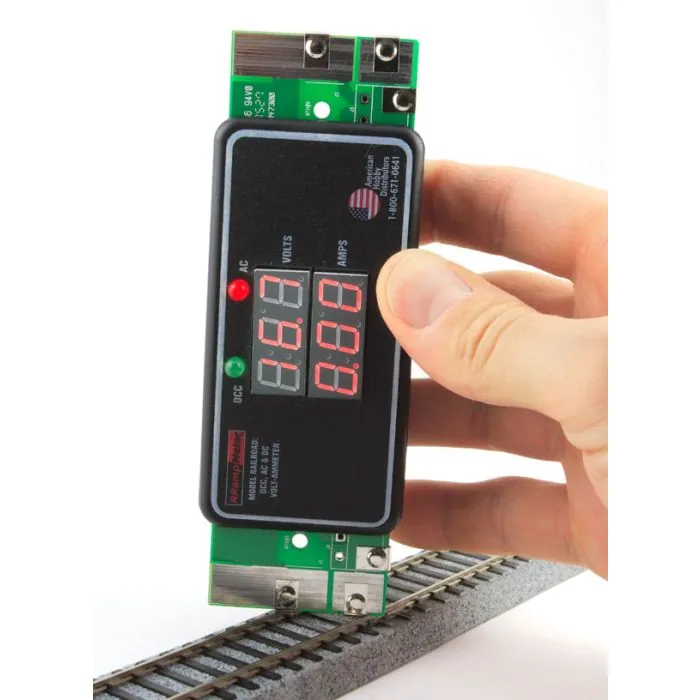
The best way to measure DCC track voltage is with a meter specifically designed for DCC, such as the RRampMeter.
An RRampMeter accurately measures:
- True DCC rail voltage
- Current draw
- Power consumption
- Decoder programming current
- Stall current
- Booster output
Knowing your actual voltage eliminates much of the guesswork when troubleshooting.
When Should You Change Your Track Voltage?
Consider adjusting your booster voltage if:
- Locomotives run excessively hot
- Decoders become unusually warm
- Models run unrealistically fast at full throttle
- You experience nuisance breaker trips
- You're changing to a different scale
- You've installed decoders with lower voltage ratings
- You're matching multiple boosters on a large layout
Often, reducing the voltage by just one volt can noticeably improve reliability without sacrificing performance.
Our Recommendation
For most layouts, we recommend using the lowest track voltage that allows your locomotives to perform realistically.
That generally means:
- N Scale: approximately 12-13.5V
- HO Scale: approximately 14-15V
- S Scale: approximately 16-18V
- O Scale: approximately 18V
Running unnecessarily high voltage rarely improves operation, but it does increase stress on motors, decoders, and electronics.
Measure your layout with a quality DCC meter, verify your booster settings, and match your track voltage to your scale. Your locomotives—and your decoders—will thank you.
Related Articles
- PSXX Electronic Circuit Breakers: Why Every DCC Layout Needs Power District Protection
- RRampMeter Review: The Essential Diagnostic Tool for Every DCC Model Railroader
- Booster Boundaries Explained: Preventing Nuisance Trips on Multi-Booster Layouts
This topic may seem simple, but getting the voltage right is one of the easiest and most effective ways to improve the performance, reliability, and lifespan of a DCC-equipped railroad.